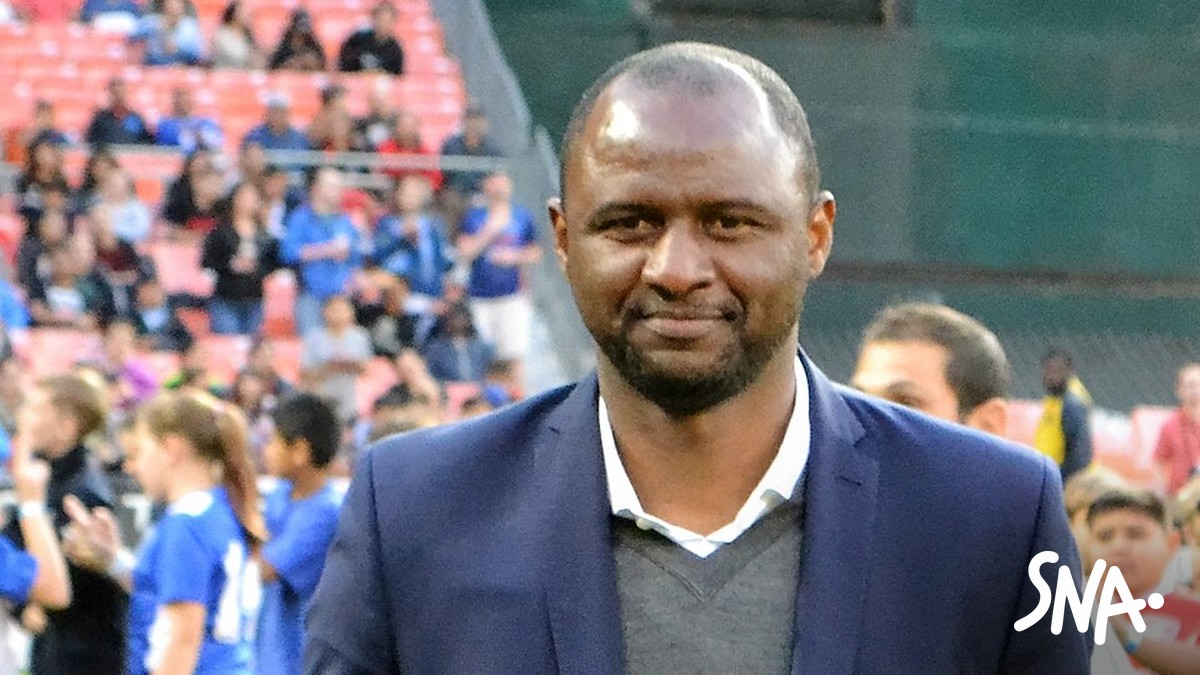
On 31 May 2002 in Seoul, Patrick Vieira was in France’s midfield. In the 30th minute, Papa Bouba Diop bundled the ball into the net and Bruno Metsu’s Senegal beat the reigning world champions 1–0. The Lions would reach the quarter-finals. Twenty-four years later, the midfielder beaten that night takes his seat on Metsu’s bench.
‘I was born here, my parents were born here, and this is a homecoming,’ Vieira said at his official unveiling in Dakar on 18 September. It is a powerful line. It also captures what the Senegalese Football Federation (FSF) was looking for: a global name, a deep connection to the country and the promise of direction after months of turmoil. The question is what Senegal expects of him, and what his coaching career suggests he can deliver.
Senegal’s next match, against Sudan on 11 November, can be followed live on SNA : goalscorers, statistics and line-ups.
From Dakar to Dreux, then Saly
Patrick Vieira was born in Dakar on 23 June 1976. He left Senegal aged eight for the Paris region, first Trappes, then Dreux, where he grew up. The rest belongs to French football: 107 caps, the 1998 World Cup and Euro 2000.
His ties to his birthplace never disappeared. In 2003, alongside former footballers including Bernard Lama and Jimmy Adjovi-Boco, he co-founded the Diambars institute in Saly, on Senegal’s Petite Côte. An academy rather than a showcase, it develops Senegalese players every day. That may be the strongest basis for his standing in Dakar, more than his honours with France.
A turbulent summer and a two-stage appointment
The FSF’s choice has to be seen against the previous ten months. On 18 January 2026 in Rabat, Pape Thiaw’s Senegal beat Morocco 1–0 in the AFCON 2025 final through Pape Gueye’s extra-time goal. On 17 March, CAF’s appeal board stripped the Lions of Teranga — hospitality in Wolof — of the title. The board cited the players’ temporary walk-off in protest at a penalty awarded to Morocco. The final was recorded as a 3–0 forfeit. The FSF appealed to the Court of Arbitration for Sport, which set a hearing for 8 October in Lausanne. The date of the ruling is not known.
Then came the 2026 World Cup. One win in four games, a 5–0 victory over Iraq, and elimination in the first knockout round on 1 July: Belgium came back from 2–0 down to win 3–2 after extra time. In mid-July, the FSF began proceedings to dismiss the coach and his staff.
On 18 August, the federation, led by Abdoulaye Fall since his election in August 2025, announced Vieira on social media and described a ‘strategic choice’, according to AFP. That same day, Le Soleil reported that discussions over contractual terms were still continuing. It took another month for Vieira to be officially unveiled on 18 September, a week before the opening match in Maputo. His ten-person staff, including three former Lions — Lamine Diatta, Abdou Kader Mangane and goalkeeping coach Khadim Faye — was not announced until late September.
Le Soleil reports a four-year contract with two targets: reach the AFCON 2027 final and qualify Senegal for the 2030 World Cup. The paper puts his pay at between 35 and 45 million CFA francs a month; Afrik-Foot reports around 35 million, roughly €53,000. The FSF has not published those figures.
Five clubs, no trophies
Senegal has not hired a novice. Nor has it hired a coach with an unbroken record of success. His five club jobs trace an uneven path.
At New York City FC (2016–2018), he twice reached the MLS play-offs without winning a round. At Nice, he finished seventh and then fifth in Ligue 1 before being dismissed in December 2020 after five straight defeats. At Crystal Palace, he finished 12th in the Premier League in 2021–2022, then lost his job in March 2023 after twelve games without a win. Strasbourg brought one season, a 13th-place finish and a departure in July 2024. Finally, at Genoa, he took over a side sitting 17th in Serie A in November 2024 and secured survival with four games to spare. The following season he left on 1 November 2025, with the club bottom on three points after nine games.
No national team on that CV. No trophies. And ten months out of management between Genoa and Dakar.
Yet the FSF’s gamble may be about something else: the dressing room. A squad shaken by a final won and then taken away, followed by an early World Cup exit, may need unquestioned authority. A 1998 world champion addressing players who grew up watching him can carry weight.
Vieira has also turned to the 2002 generation that beat him in Seoul. Khalilou Fadiga attended his unveiling. ‘Their experience is important for this new generation of young players,’ the coach said of the former internationals. El Hadji Diouf, his opponent in 2002, is not part of the technical staff.
His spell at Genoa also showed that he can quickly turn around a struggling side. That is a useful skill for a national team that meets for only a few days each quarter.
Time: what he needs most
One question remains. Can a coach who has never stayed anywhere for more than two and a half seasons, and whose jobs have often ended in poor runs, succeed when his work is measured in international windows? A national team does not offer a whole season to put things right.
The schedule is tight. AFCON 2027 will take place in summer 2027 in Kenya, Uganda and Tanzania, and only four qualifying games remain. If reaching the final is indeed the FSF’s target, as Le Soleil reports, Vieira will have less than a year and a handful of camps to build a team capable of doing it. After the summer Senegal has endured, time is precisely what Lions fans may be least willing to give him.
There are unknowns too. Neither the contract nor the detailed targets have been published. And the CAS ruling on the AFCON 2025 final, when it comes, could affect the mood of the squad.
On the pitch, the results are respectable: 1–1 in Mozambique on 25 September, then a 1–0 win in Ethiopia on 29 September through Ibrahim Mbaye’s 11th-minute goal. In a friendly at Marseille’s Vélodrome on 4 October, the Lions then beat Comoros through Iliman Ndiaye. After two qualifying rounds, Senegal are second in Group J on four points, level with Mozambique, who lead on goal difference (+3 to +1). Sudan have three points and Ethiopia none. The top two in each group qualify.
On 11 November, the Lions host Sudan (follow the match live on SNA), before the return game on 15 November. By the end of that second meeting, Senegal will know whether Patrick Vieira’s homecoming has begun with solid foundations or warning signs.
Live SNA match pages: goalscorers, statistics and line-ups.
25 September 2026: Mozambique – Senegal (1–1)
29 September 2026: Ethiopia – Senegal (0–1)
11 November 2026: Senegal – Sudan (upcoming)
15 November 2026: Sudan – Senegal (upcoming)
SNA — West Africa
Photo: Simon Heseltine / Wikimedia Commons, CC BY-SA 4.0
Source: Sport News Africa.
Read the original and its updates on SNA